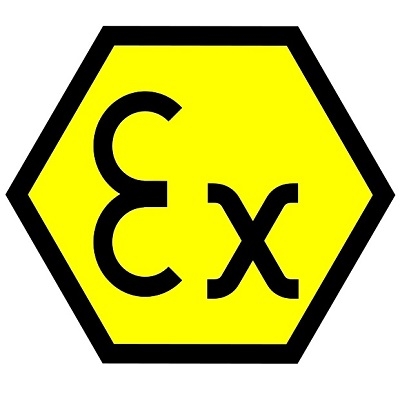
ATEX More Information...
ATEX & Two-way Radios
This is not a comprehensive list and is focused as a simple guide for assisting with the selection of ATEX two-way radios. For more detailed explanation about ATEX please check the HSE website (See our Links page).
ATEX approved two-way radio equipment meets the European Directive 94/9/EC, and provides a safe solution to radio communications for potentially explosive atmospheres.
ATEX approved radios are manufactured to very stringent requirements and high manufacturing standards to reduce or eliminate any risk of generating the tiniest spark as well as heat produced by the device. From the radio casing to batteries, everything has to be constructed for safety. ATEX radios operate at a lower output power and are normally IP67 compliant to protect them from dust and allowing immersion in water. ATEX radios may be coloured blue and marked with an ‘EX’ symbol indicating ATEX certification.
There are a number of classifications for ATEX equipment. These can be chiefly divided into two Groups I and II. Equipment within the Group I can be used in mines or similar environments that are susceptible to methane. Group II equipment can be used in other areas than mining where explosions can occur such as the oil and gas industry, power stations and ports.
I is solely for mining applications.
II covers all gas hazards and is shown as IIA, IIB or IIC (below) which relates to the potential gases that may be present.
III indicates dust hazards and again is split into IIIA, IIIB and IIIC categories. IIIA relates to combustible filings. IIIB is for non-conductive dusts and IIIC for conductive dusts.
In general, whether it is marked as II or III for the gas group, the C rating is always the safest as it relates to the biggest risk protection.
Group II can be divided into three subgroups.
IIA: For atmospheres containing propane or gases of an equivalent hazard.
IIB: For atmospheres containing ethylene or gases of an equivalent hazard.
IIC: For atmospheres containing hydrogen or gases of an equivalent hazard.
For a slightly more in-depth breakdown of the classifications, please look at the list below.
ATEX 'Mining' Protection and Meaning
I: Group I, Mining
M2: Must be switched OFF in case of firedamp
Ex: Explosion proof equipment
ib: Intrinsic safety
I: Protection in mining group: Methane
Mb: Mining equipment protection level: High protection
ATEX 'Gas' Protection and Meaning
II: Group II, other (non-mining) areas
2: High level protection for use in Zone 1 (gas)
G: Gas, vapour and mist
Ex: Explosion proof equipment ib: Intrinsic safety
IIC: Protection in GAS group Acetylene, Hydrogen
T4: Device surface temperature will not exceed 135°C
Gb: Gas equipment protection level: High protection
ATEX 'Dust' Protection and Meaning
III: Group III, other (non-mining) areas
2: High level protection for use in Zone 21 (dust)
D: Dust
Ex: Explosion proof equipment
ib: Intrinsic safety
IIIC: Dust group: Conductive dust (R≤10³Ωm)
T110°C: Maximum temperature of device surface
Db: Dust equipment protection level. High protection
Note: T4 temperature specification to 135°C is normally as the requested industry standard.
Despite the potentially dangerous scenarios, ATEX 2-way radios are the best way for your organisation to communicate, in the event of any emergency or to make quick decisions when needed.
It is your responsibility to select and use the correct radio for the operating conditions/environment.